Posted on Leave a comment

New Book from Dr. Bonnette: Rational Responses to Skepticism

Rational Responses to Skepticism: A Catholic Philosopher Defends Intellectual Foundations for Traditional Belief by Dennis Bonnette, Ph.D.

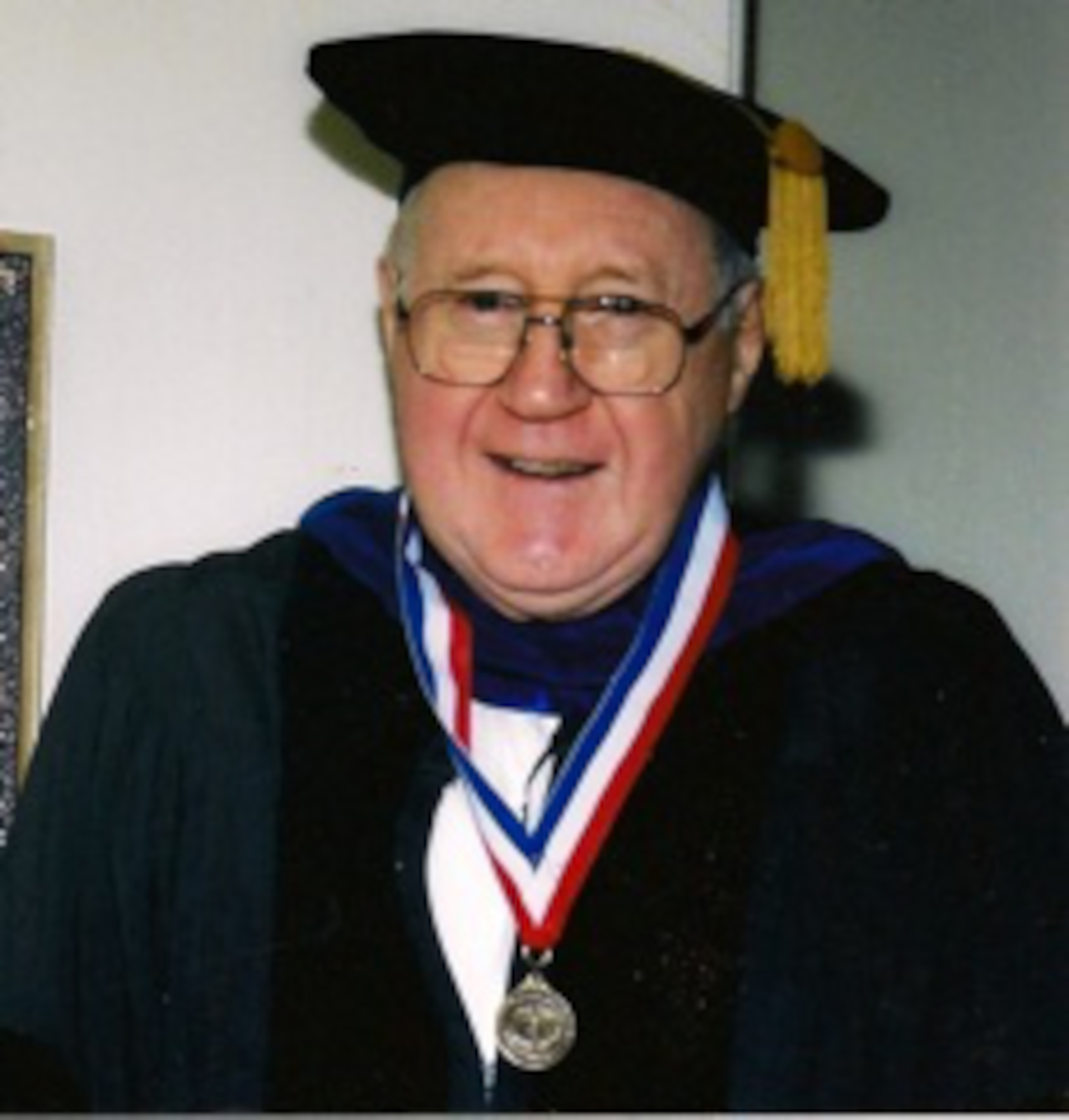
Dr. Dennis Bonnette has devoted much of his life to defending the use of reason against naturalistic arguments against God. Throughout the years, he has written many articles on topics concerning the problem of evil, proofs for the existence of God, and many more topics crucial to maneuver our naturalistic age.

Rational Responses to Skepticism: A Catholic Philosopher Defends Intellectual Foundations for Traditional Belief is a compilation of recent articles and essays he wrote to address common, vexing philosophical questions.

A master of clarity and precision, Dr. Bonnette’s firm grasp of reality makes his calm, Thomistic explanations succinct, thorough, and thrilling. Written for the layperson, the articles included in this book are accessible to those who do not have a background in philosophy. The full-size font, soft white pages, and ample margins throughout the text enhance the readability of this useful book. Praise to the publisher for taking no shortcuts.

From the jacket of the book:

“Following an avalanche of spirited criticism from skeptics, agnostics, and atheists, who have provided forceful intellectual attacks against Thomistic philosophy and Catholic apologetics – including objections posed by naturalism and contemporary analytic philosophy, Dr. Bonnette has assembled a collection of his most salient articles containing a reasoned defense of the Catholic faith. These articles are organized within this book into sections that (1) demonstrate the weaknesses of today’s philosophy of naturalism, (2) defend epistemological certitudes and metaphysical universal principles, (3) study man — the unique spiritually-souled animal, (4) prove God’s existence, (5) examine God’s nature, (6) solve the problem of evil, (7) defend natural law ethics, and finally, (8) rationally examine various revealed realities — from Adam and Eve to modern-day miracles. A must-read for Catholics who want reasoned responses to common criticisms of classical theism and their faith”

Aquinas School of Philosophy is in no way related to En Route Books and Media. The link provided is not sponsored, nor will the Aquinas School profit from any purchases made. We are promoting it out of support for true teaching of philosophy, not for monetary gain.

Link to purchase:

https://enroutebooksandmedia.com/rationalresponses/

Posted on Leave a comment

From Economic Slavery to Freedom

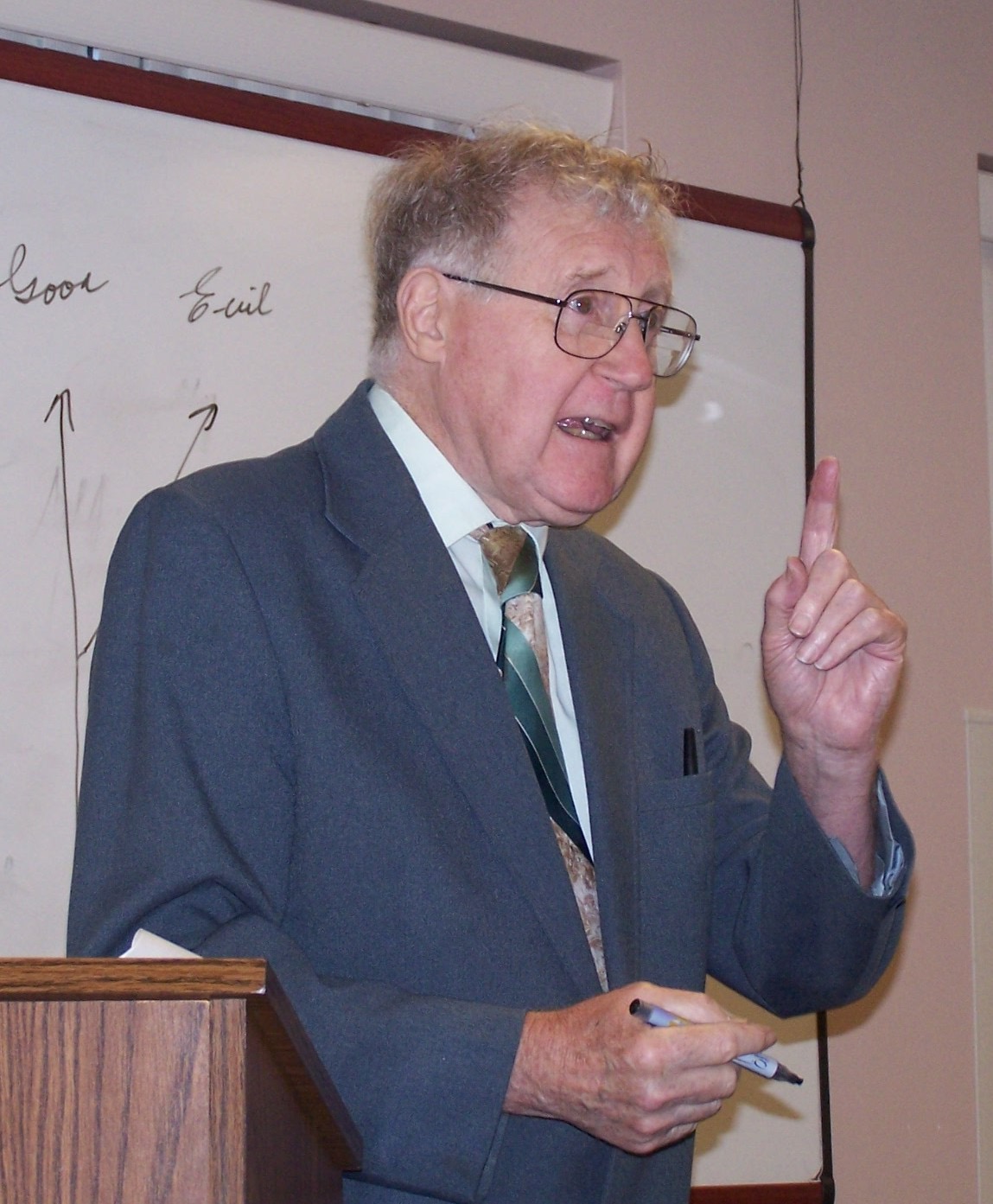
“From Slavery to Economic Freedom” is a previously unpublished work from Dr.Raphael Waters (above) that bears 

careful consideration. Completed in 2005, it approaches the economic question from a Thomistic understanding of the body politic and the common good. 

By Raphael T. Waters, D. Ph., L. Ph., Ph.C. 

“…leisure is necessary both for the development of virtue and the performance of political duties.”

Aristotle, Polit. VII, ch. 9, 1329a, 1-2

PHASE A: THE PROBLEM

I: The nature of capitalism

The term `capitalism’ is one of the most confusing terms in the English language. For this reason, it has been remarked that Pope Pius XI, in his encyclical ‘“The Social Order”, avoided the use of the term altogether.

While some have explained it as the use of money, goods, or services in order to gain a monetary return, others explain it as an economic order wherein the workers are employed by wealthy owners who enjoy the fruits of worker’s labor. Hence, they conclude, it is a system of exploitation and great injustice.[1] 

However, in order to throw some light on this subject, we first need to have some understanding of the nature of the body economic. The measure in the practical order is the end,[2] and in the case of the social order, the end is the common good.[3] Thus: 

There is a certain resemblance between the human body and the body economic inasmuch as they are both the underpinning or basic structure of the life of man and society. For, just as the healthy state of the human body is a condition that allows higher functions to operate, so if the body economic does not function well, then time for man’s higher pursuits is not readily available. On the other hand, if the economic order is in good health, we will be able to save time and effort–leisure– allowing man time to attend to higher goods in the body cultural.[4] 

II. The common good of the body economic 

Men work in groups for the sake of a common good, which is defined as the good of the whole and the good of the parts. It is then an immaterial good since it has to be shared by each and all. In the economic order, the good sought by the cooperation of men exchanging goods and services, is leisure, that is, saving time and effort. For example, Jones (potato grower) exchanges two bags with Smith (boot-maker) one pair of boots. Each gets out of the act of exchange exactly what he puts into it, it seems. However, they provide a free gift for each other, having saved time and effort by producing the others merchandise. 

Man has a strong natural desire to save himself time and effort. For example, if there is a vacant lot on a street corner, pedestrians will take a short cut by walking diagonally across the lot. 

Although the term “competition” signifies “seeking together,” it is currently used to mean “opposition,” thus ignoring the true economic process. For, what we are seeking together, by cooperative activity, is the common good, leisure.[5] We save effort for each other. 

Moreover, the more people there are to do acts of exchange, the more effort we should save. If some made trousers, others refrigerators, calculators, battleships, skyscrapers, or grow food there will be a tremendous saving of effort as acts of exchange take place in the marketplace, that is, in the banks.

III: Man is by nature an owner [6]

Since “there can be no coordination without subordination,” someone has to be responsible as owner or, at least, take charge of each enterprise.[7] However, there are different kinds of ownership, which may be reduced to private (including share ownership) and state ownership.[8]

It is quite clear that men and women, either individually or as share owners, should be the true owners of property. However, just as every man, because he is rational, laughs, talks, is a social, political, scientific, economic, artistic and religious animal, so likewise, he is naturally inclined to be an owner of private property, for ownership is necessary for man, either 

1) individually, because of his natural tendencies, desire for liberty, and his dignity as a person, or,

2) socially, because of peace, order, to avoid animosity, and for efficiency.[9]

IV. The pathological state of the body economic 

If leisure should be more available with increase of population, why are so many dispossessed of private property and have little freedom from drudgery, both of which were exploited by Karl Marx? 

Research into the history of mankind can be very revealing. We find, for example, that in fifteenth century England, a man had to work only 2 1/2 days a week to earn his living. I use Great Britain as an example, for the best records are kept there. In other places, wars and various upheavals have allowed destruction of early records of human affairs. 

It should be noted that, in the past, men had a lot more leisure comparatively than we have today. Roman de Fauvel explains that, 

“Activity occupying one-third of a lifetime must be culturally significant. While conditions varied with the country and the century, the medieval Christian calendar generally mandated fifty-two Sundays of enforced leisure plus, from the twelfth century on, at least forty saints’ days. To these holidays could be added unlimited local church feasts averaging more than thirty, creating an astonishing 126 or more days per year in which work was not allowed. Englishmen added celebrations of St. Swithin’s Day… Canterbury townsfolk honored by holiday, not only St. Thomas Becket but also Sts. Alban, Dunstan, Ethelreda, and Edward the Confessor. Universities had their own holidays; fourteenth-century Montpellier’s seventy-seven, plus Sundays, totaled 133 yearly festivals. Moreover, many holidays were not limited to twenty-four hours.”[10]

It is significant to learn that, 

“Cobbett, in his History of the Protestant Reformation, has made an exhaustive study of just this question of the material and economic condition of the people of England before and since the reformation. He says: everything shows that England was then a country abounding in men of real wealth… They are fed in great abundance… Every one, according to his Rank hath all things which conduce to make mind and life easy and happy.”[11] 

Pearce makes a comparison:

“There are no natural sinecures. Rent is the natural source of communal revenues. In this sense, the Feudal system was more of an exchange economy than ours is. In these days, before the modern centralized state had arisen, government was largely local government and the rent receivers rendered to the people services of a public or common nature, e.g., public defense, education, worship, care of the sick, legal administration, schools, universities, pensions for the aged and the widowed, bursaries for the young, endowments for marriage, etc. But, we have changed all that medieval nonsense. Now rent is the perfect sinecure, i.e., command over exertion (value), without any rendering of exertion (cost), capitalizable usury. It is a right without any duties, property without responsibility, that contradiction called a valuable income—an income that can be bought and sold.”[12]

In case one should suppose that other human needs are neglected, consider the following:

“Their attention to hygiene can be best shown by a consideration of the hospitals….These generations gave us a precious lesson by eradicating leprosy, which was as general as tuberculosis is now [at the time of writing]….”the hospital erected at Tanierre, in France, in 1293…the sister of St. Louis. [A] modern architect, says

‘It was an admirable hospital in every way, and it is doubtful if we today surpass it. It was isolated, the ward was separated from the other buildings; it had the advantage we often lose, of being but one story high, and more space was given to each patient than we now afford.

“The ventilation by the great windows and ventilators in the ceiling was excellent; it was cheerfully lighted, and the arrangement of the gallery shielded the patients from dazzling light and from draughts from the windows, and afforded an easy means of supervision, while the division of the roofless, low partitions isolated the sick and obviated the depression that comes from the sight of others in pain.

“It was, moreover, in great contrast to the cheerless white wards of today. The vaulted ceiling was very beautiful; the woodwork was richly craved, and the great windows over the altars were filled with colored glass. Altogether, it was one of the best examples of the best period of Gothic architecture.”[13]

It is startling to learn that although the year 1495 is considered to be the peak of economic development in England, yet within a hundred years or so, they had to introduce the poor laws. This happened with the upheavals caused by ruthless men throwing off religious restraint, and the arrival of the black plague, which killed off the fittest men.

You might claim that at that time, men had far fewer needs and wants whereas today these have increased considerably, for example, television, automobiles, computers, microwave ovens and so on. 

Let us say that the goods we want have increased 100 times. But, our capacity for production has increased 1000 times. If this is true, then why don’t we have a greater saving of time and effort? 

Many people today have to have more than one job to support a family. Husband and wife are forced to go out to work whereas, even if only for the proper use of the division of labor, it would be better for the wife to be able to stay at home, instead of being forced out of the home as many are now.

PHASE B: THE CAUSE OF THE PROBLEM

V. Two capitalisms 

Let us return to our concept of capitalism whereby men invest money, goods, or services to get a return or profit for their outlay. I have noticed that authors, lecturers or teachers don’t seem to question what is done with the money. In other words, what is the end of the act of investment?

There are two ways one can invest money or two ends which can be sought:

production, or, anti-production. Consider the following examples:

First: Suppose that I want to start a taxi service. First, I require:

–a car which costs, say, $20,000; I should expect interest on this. 

–then I require a license which, I quickly find out, are issued on a limited basis at a cost of about $25. On the other hand, here are some figures showing the actual market cost of a taxi license:

In the 70’s, the average in American cities: $70,000 

In the late 80’s, $140,000 in Toronto. 

In New York, it was recently reported that a license costs about $200,000. 

Taxi owners naturally expect interest on this amount also. In effect, owners would be buying into a monopoly. 

Second: Nutmegs during World War II. A simple item was monopolized.

Third: Glass manufacturers in Australia; ten organizations were reduced to one.

Fourth: Suppose I wanted to make three-headed Teddy Bears. If no one else wants to make them, I can become a monopolist! But what is wrong with that? Surely, if no one else wants to make them, I should not be obliged to stop production. It is not an anti-social act for me to keep supplying them.

But, if I invest money to stop someone else from producing them, that is an anti-social act and therefore an immoral act. The government, guardian of the common good, has a grave obligation to outlaw such investments.

Men are producing goods and services every day; farm goods and manufactured goods are pouring onto markets. This deserves the name of normal capitalism. But the minute I invest to stop another so that I can corner a market, this should be called spurious or morbid capitalism.

This practice was known in the ancient world. It has been explained brilliantly by Henry Pearce within the past 60 years.[14]

Note the cases recorded by Aristotle: 

Thales[15] was being ridiculed for being a philosopher. Being quite clever at reading the stars to predict future weather, he discovered that the next summer would bring a bumper crop of olives. He then put deposits on all the local olive presses. Aristotle wrote that Thales made a lot of money because the olive growers had to come to him after he had raised the price for using the presses. Thus, he taught the people a lesson.

Aristotle also noted that,

There was a man of Sicily, who, having money deposited with him, bought up all the iron from the iron mines; afterwards, when the merchants from their various markets came to buy, he was the only seller, and without much increasing the price he gained 200 per cent.”[16] 

Later, St. Thomas Aquinas in the thirteenth century explains the principle informing us that a man could go ahead to a play to prepare the way for his friends coming after him. But if he goes ahead to hinder their way, he commits a grave anti-social act. Therefore, it is an evil act. It is quite clear from the context that St. Thomas is referring to property matters and business affairs.[17] 

Thus, there are two ways of investing money:

– one way which is for the sake of production of goods and services and another which is anti-productive.

If I invest to stop someone else from producing, it is an anti-productive investment for I am interfering with the exchange process, and therefore stealing the time and effort of others who have to work harder to obtain the same leisure.

Some examples of cornering a commodity in a modern society are: 

In Ottawa, Canada, I was informed when I lived there, that all the land around the city was owned by six companies. I was also informed by the secretary of the taxi drivers union, that all the taxis were owned by three companies and one of these had spent a lot of money trying to take over the other two companies.

Again, in Canada three different researches have shown that Canada is owned by about 350 families. I suspect from some casual reading, that the USA is owned by about 2,000 families.

No wonder Henry George entitled one of his works Progress and Poverty in which he shows that with progress comes poverty. Marshall McLuhan said that affluence creates poverty. For the rich get richer and the poor get poorer. It seems that the main underlying cause is anti-productive investment. Couple this with the economic imbalance developing in our populations, and one can see that we are in for much trouble. 

The following can be used for anti-productive purposes: takeovers and mergers; deliberate creation of shortages; advertising; kickbacks; calendar marketing agreements; loss leaders and so on.

In sum, there is no reason why one shouldn’t earn his living—even with a monopoly–but he cannot perform an immoral act in order to establish a monopoly, that is, by preventing another from earning his living.[18]

VI: Results of anti-productive investment

These are some of the effects of that pernicious practice:

First, unjust distribution of wealth. The means of production become concentrated in the hands of fewer and fewer citizens.

Second, more and more so-called social programs are established by the government under pressure from the people. Thus, more and more control is put into the hands of government as we develop the welfare state; this is a step closer to the absolute state, the socialist society. Needless to say, these institutions are contrary to the natural moral law.

Third, men lose their freedom a little at a time.

Fourth, inflation.

Fifth, taxation runs wild.

Sixth, finally, some powerful government has to take control in order to sort out the mess. Germany was an example of this following WWI. This is a chance for the ruthless, the strong, and the cunning to take over the whole social order.

There is no doubt that the consequences of this evil practice– spurious capitalism– must carry the blame for many of our economic and other social ills. We see the rich getting richer and the poor getting poorer. But you might argue that the poor are far better off today than people were, say, of the nineteenth century. Yes, but if proper comparisons were made, they should be far better off than they are now. 

PHASE C: IS THERE A SOLUTION

VII: Is there a solution?[19]

The welfare state, no doubt, has saved many from dire poverty. But that doesn’t seem to be working very well. Many, for example, receive food, medicine, housing, and schooling from government sources now– and at what a price– loss of freedom! Here we might consider some solutions:

First solution, socialism: 

Some have claimed that, since men cannot be trusted to own property, the obvious solution is to take property away from the people and make the government the only owner.

Aristotle did a splendid analysis of this solution and so have others, exposing its erroneous nature.[20] Three principal arguments against socialism are:

1. The function of a government is to govern, not replace its citizens.

2. What can be done by the lower ought not to be done by the higher (principle of subsidiarity).

3. A step towards dependence is a step away from independence, that is, from freedom.

While we argue against the idea of state ownership, we should realize that the government ought to own certain property, for example, the public goods, which serve the common good. These are the instruments of the common good; such are government buildings, parks, police cars, military schools, warships and so on. BUT, we see that these are exceptional cases—public goods which subserve the common good– and that socialism is not a true solution. Socialism can only take away our freedom.

Second solution:

We ought to have education concerning the true nature of man, society and the common good. For, it should be carefully noted that the function of a government is principally educative, that is, to point out to the people what we are doing wrong if we stray from seeking the common good. Citizens should be told what they are missing by failing to preserve that social end.

It is the function of a government to remove impediments to the common good. Compare this with the following:

• a physician does not heal the patient. He removes whatever is preventing the patient from healing himself;

• a teacher does not cause the understanding in the mind of the pupil. The teacher removes obstacles so that the student can grasp what is being taught.

• an orchestra leader does not produce the harmony. This is achieved by the players working collectively while the conductor removes the obstacles to harmony.

• the manager does not build cars; he coordinates etc.

In a similar manner, the government, using its appropriate instruments, should remove obstacles so that the citizenry can work towards the common good — leisure, the saving of time and effort.

The government can make laws to help it in its task of guiding the people while it can use its power of taxation wisely. Remember: our freedom is at stake.

If the impediments were removed, men and women could earn their living without fear of losing what they have built up; and the great gap we see today between those who possess property and those who do not, could be drastically reduced.[21] Then, there would not be the burden on society of having to look after poor people. Everyone would be able to look after themselves. 

Moreover, it is my own opinion that a one-day working week would be possible. Absurd taxation would be removed and we could reduce top-heavy government departments. Thus, we would be able to abolish the cost of an army of accountants, extra taxes, and other burdens on society.

Why shouldn’t we levy tax on what society has produced, namely, land values? What has been created by society should go back to society.[22] If this was done fairly, perhaps we could quickly abolish tax on our personal efforts. 

Then, if we give free reign to true capitalism, that is, productive capitalism, there could be peace and prosperity and a great surge in the pursuit of happiness. Men could give their energies to exploration of the world of plants, insects, animals, diseases, the arts, music, and better understanding of the nature of the human person and its social implications.

A Final Word:

This is an age of anti-intellectualism in which we tend to solve many issues with our hearts and not our heads. For example,

For venereal diseases: We wrongly recommend condoms, not chastity.

For crime: We wrongly recommend more police, not the Ten Commandments.

So, for poverty: We wrongly recommend welfare dispensed by the state, not curing the diseased state of the body economic. Many moderns try to force immoral solutions on us since they cannot solve economic problems facing governments. They resort, for example, to abortion and euthanasia in various guises, such as “Do not resuscitate” orders.

If we ignore the basic error in the economic order, namely, that through man’s individual efforts, true ownership by every human person is extremely difficult to obtain for some, and we allow even the abuse of the ruthless, the strong and the cunning to acquire wealth in any manner they choose, we have nothing to lose–except perhaps, only our life, liberty, and the pursuit of happiness. “.”The remedy for [the evils (?) of] capitalism lies in the recognition and practice of the social obligations which attach to ownership. Both the individual and society have a positive part to play in order that the remedy be effective.”[23] 

Therefore, we must conclude that the system we call ‘capitalism’ is in itself not a doctrine of greed but becomes so only when some citizens, imbued with a poor sense of values and acting with great ignorance, perform unnatural economic acts, seeking illegitimate ends, which activities run counter to the common good. 

Notes:

1. Cf. Thomas Higgins, Man as Man. The Science and Art of Ethics,261;cf. Ayn Rand, Capitalism, The Unknown Ideal, New York, New American Library, 1946 (Signet Book), 18-19: a useless definition from material causes; Johannes Messner, Social Ethics. Natural Law in the Western World.

2. D. Q. McInerny, Metaphysics, ch.14.

3. Aristotle, Nicomachean Ethics I, ch.1; Politics, I, ch.1; St. Thomas Aquinas, Summa Contra Gentiles, III,ch.1,2

4. Aristotle, Nic. Ethics

5. Aristotle, Polit. VII, ch. 14, 1333a, 36-1333b, 2; 1334a, 5-6; 1334a-ch.15, 1334a, 18; VIII, ch3, 1338a

6. Higgins, op. cit., 287

7. Aristotle, Pol. II, ch.5; St. Thomas, Summa Theologica II-II, q.66.

8. Thomas Higgins, Man as Man: The Science and Art of Ethics,283ff.; Johannes Messner, Social Ethics

9. II-II, 66, 1; Higgins, 287-288; Messner, 821-824.

10. Lynn Thorndike, The History of Medieval Europe, 333

11. James Walsh, The Thirteenth, The Greatest of Centuries, 481, cf.479.

12. Henry G. Pearce, Value, Normal and Morbid, Sydney, The Standard, Daking House, 1946, 186.

13. Walsh, op. cit.

14. H. Pearce, ibid, passim.

15. Politics I, ch.11, 1259a, 5-23.

16. Ibid, 1259a, 1, 23-27

17. II-II, q.66, a.2, ad 2.

18. Higgins, op. cit., 315-316

19. Higgins seems to miss all the above in his attempt to offer a solution to the problems of capitalism: thus, op. cit., 288-290.

20. Politics II,ch.2ff.

21. Higgins,op.cit., 288-290.

22. Henry George, Progress and Poverty.

23. Higgins, op. cit., 288.
Posted on Leave a comment

A Great Thomist is Gone

Dr. Raphael Waters, R.I.P.

By John Vennari

“If the Lord takes me soon, be assured that I will be praying for you.” Dr. Waters said this to us, a group of his students, who visited him at his home on Friday evening, August 20.

We would not see him again. He died the following Thursday, on August 26 at 4:30 am in St. Mary’s Hospital in Lewiston, NY, at age 86. 

His death is an incalculable loss.

Apart from being an internationally recognized scholar who was a member of several prestigious scholarly associations, he was also a lively and humorous professor whose intense love of philosophy was as contagious as it was exhilarating.

He died in the saddle, continually planning new courses to teach as he was slowly consumed by cancer and other painful maladies. 

A Unique Pedigree

Dr. Waters was buried on September 1, 2010, one hundred years to the day from St. Pius X’s promulgation of the Oath Against Modernism, in which St. Pius X taught, “In the future the doctorate in theology or Canon Law must never be conferred on anyone who has not first of all made the regular course in scholastic [Thomistic] philosophy. If such a doctorate is conferred, it is to be held as null and void.” 

It was Pius X who taught in his magisterial decrees that scholasticism is a central component in the combat with Modernism. Some of those at the funeral remarked that it appeared to be one of those ironies of Providence that Dr. Waters, one of the last of the great Thomists, should be buried on this significant anniversary.

Dr. Raphael Waters was a Master of Thomistic philosophy who possessed a pedigree that few others could boast. Born in Australia, and years later starting his career as a pharmacist, he became a student of the eminent Father Austin Woodbury at the Aquinas Academy in Sydney, a unique institution in the world.  The school could not grant any degrees, yet people from all walks of life flocked to it because of the genius of its founder and instructor.

Father Woodbury, widely-known as “Doc” Woodbury, was trained by Father Reginald Garrigou-Lagrange, arguably the greatest Thomist of the 20th Century. Raphael Waters studied at the feet of Father Woodbury for decades. He took all the courses at the Aquinas Academy twice, and later became Father Woodbury’s co-teacher.

Dr. Waters traveled to Canada to further his studies, where he received three canonical and civil degrees in Philosophy from the University of Montreal. These degrees established him as qualified to teach in any Catholic seminary in the world. 

In Canada, he studied under world-renowned masters such as Fathers Louis-Marie Regis and Louis-Bertrand Geiger. He said repeatedly, however, that the best of all his masters who towered head and shoulder above the rest was the “boy from the bush,” Father Woodbury.

For seven years he served as assistant professor of Philosophy at the University of Ottawa. In 1976 he accepted a position at Niagara University in Lewiston NY, where he served as Professor of philosophy until he resigned in 2004.

In 2005, he founded the Aquinas School of Philosophy. This was the last great project of his life to which he devoted all of his time and energy. 

He lectured every Friday night, first at a parish church hall in Niagara Falls, then at the Education Room in St. Mary’s hospital in Lewiston. The classes were free and open to all.

Dr. Dennis Bonnette, retired professor of philosophy from Niagara University and long-time colleague, who also teaches at the Aquinas School of Philosophy, said in tribute to Dr. Waters the day after his death, “Dr. Waters’ entire life was devoted to what he called the Apostolate of Scholarship… nobody was more dedicated to his students, spending many hours with them.”

The love Dr. Waters nursed towards his students was evident from the tributes they voiced after his death. 

One former student drove from North Carolina to attend the funeral. Others wrote touching tributes on his webpage obituary. One reads, “I was a student on Dr. Waters at Niagara University. I remember Dr. Waters fondly. He was a dedicated teacher who cared deeply for his students. Thank you, Dr. Waters, for courageously teaching the truth.” 

Father Francis DeRosa, a former student of Dr. Waters, drove from Virginia to celebrate the Funeral Mass in Niagara Falls. In his homily, Father DeRosa said that apart from his parents, Dr. Waters was the single most determining factor in his decision to become a priest: “It was through the teaching of Dr. Waters that I truly came to understand the Catholic Church as the one true Church established by Christ.”

Dr. Waters’ dedication to scholarship is demonstrated by the fact that upon retirement at age 80, when many a man is ready to “take it easy”, he went on to found his own school: The Aquinas School of Philosophy. He did this to keep alive the vital philosophical teachings of Aristotle and St. Thomas Aquinas so woefully neglected in our time. 

Indeed, he embodied 2500 years of the best of Western philosophical thought, and believed himself duty-bound to continue transmitting these great truths to others for as long as God gave him life.    

Thomism Scorned

Dr. Waters was appalled at the state of education, and especially at the state of philosophy taught in Catholic colleges and universities. Thomistic scholasticism is out of fashion among Catholic academics, and has been so for decades. 

Even prior to Vatican II, the progressivist proponents of the “New Theology” scorned scholasticism, claiming it too difficult for modern man to understand, and propounded new philosophical systems such as existentialism that would allegedly speak to modern man in his own language. 

As early as 1950, keen Thomists such as Father David Greenstock warned against this new development: “We are asked to accept, in exchange for this solid foundation [of Thomism], the fluid concepts of a new philosophy, destined to change with time – we are told – like everything else in this fluid world. This, to our way of thinking, is not merely unreasonable, but also very dangerous.”

This new approach lacked the clarity and precision of Thomistic philosophy and introduced much mischief. It also cut the Catholic from his past, making the centuries-old Catholic language of scholasticism a foreign language to him.

This new approach was also the basis for progressive bishops and theologians at Vatican II to insist that Council documents be drafted in so-called pastoral (ambiguous) language. For example, the Decree on Ecumenism never defines ecumenism. The Council lays stress on “human dignity”, but never defines human dignity, etc.

Even Father Joseph Ratzinger, a young progressive theologian at Vatican II who was an adherent of the New Theology, rejoiced that the Council documents would not be drafted in scholastic terminology, as has been documented in past issues of Catholic Family News.

This lack of precision of Vatican II documents was alluded to by Bishop Thomas Morrow, a prelate who attended the Council. Catholic World News reported Bishop Morrow’s statement, “I was relieved when we were told that this Council was not aiming at defining or giving final statements on doctrine, because a statement of doctrine has to be very carefully formulated, and I would have regarded the Council documents as tentative and liable to be reformed.”

The chaos resulting from these documents is well attested by the present ruinous state of the Church throughout the world. The very fact it is commonly held that Vatican II documents can have both a liberal interpretation and a conservative interpretation (the hermeneutic of discontinuity/hermeneutic of continuity dichotomy) testifies to the want of scholastic precision in the documents themselves. No one even pretends the Decrees of Trent or Vatican I can be interpreted in any other manner than the precise language in which they are written. 

The wholesale abandonment of scholasticism quickly spread throughout Catholic universities, where the philosophy of St. Thomas Aquinas was ignored, and a confused modern approach put in its place. 

The Science of philosophy is replaced with the “History of Philosophy”, which introduces the student to hundreds of conflicting thinkers, but never teaches the student how to think. This results in the belief that philosophy is nothing more than a contradictory jumble of personal ideas and ideals.

“The ‘History of Philosophy’ is the worst way to teach or study philosophy”, insisted Dr. Waters. A History of Philosophy course has its place for students who already have years of solid philosophical instruction, and whose minds are trained in the true science that gives them the ability to recognize errors of deceptive systems. 

It is akin to attending a school of architecture where the student is taught a history of the various styles of structures from ancient Greece to modern New York, but never learns how to build a building. 

The disorder in philosophy is worse, as it necessarily flows into confusion in Ethics, and to a grand perversion of the way Ethics is taught. The modern instructor does not teach the student the sound objective principles of Aristotle and Aquinas by which to judge moral actions. A contemporary Ethics course often consists of a text book that is merely a collection of essays from various authors presenting conflicting views. On Abortion, two essays in favor, two essays against; Euthanasia: two essays in favor, two essays against; Capital Punishment: two essay in favor, two essays against.

The student, who is not taught any firm principles by which to judge, is then told to make up his own uninformed mind. In the end, the student will be swayed in moral matters either by gut feeling, or by personal interests, or by popular liberal sentiment. The deformed student will also come to accept the prevailing error taught in modern universities: that there is no objective moral law.

This is not education, but deformation. One can only pity students and their parents who spend vast sums of money, and go into debt for years, to receive this perverse de-education.

Philosophy is a Science

By contrast, Dr. Waters, along with Father Woodbury and St. Thomas Aquinas, rightly teach that philosophy is a science that gives certitude to the mind. Dr. Waters defined philosophy as “certain knowledge of all things through their ultimate causes in the light of the principles of reason.”  

By “certain knowledge”, he means “sure knowledge”.

Dr. Waters’ mentor, Father Woodbury, spends a remarkable nine pages in his unpublished Introduction to Philosophy, demonstrating with pitiless logic: “Philosophy is knowledge of all things through highest causes, proceeding under the natural light of human reason.” Here, both Dr. Waters and Father Woodbury simply reiterate the teaching of St. Thomas Aquinas: “Wisdom [i.e. philosophy] is the science which studies first and universal causes; wisdom considers the first cause of all causes.”

Philosophy differs from the experimental sciences as it studies the ultimate cause of all things. 

For example, as the philosopher Brother Benignus noted, the science of physics formulates the laws of motion, but it does not answer the question “Why is there motion in the universe”? Biology sets out to explain the functions, likeness and unlikeness of living things, but it cannot answer the origin, principle and purpose of life. Experimental psychology seeks to describe the behavior of man, but it cannot answer the questions: “What is man?” or “what is the reason of man’s existence?”

“The philosopher is above all the guardian of the principles of reason”, Dr. Waters taught. Principles of reason are so fundamental that they cannot be proved, only defended. Some of these principles of reason include:

• Nothing can both be and not be at the same time and under the same circumstances (this is the principle of non-contradiction which is the most fundamental principle of reason).

       • Whatever undergoes movement is moved by another;

       • Every agent acts for the sake of an end;

       • The whole is greater than its part;

       • It is never lawful to do an evil act for the sake of a good end.

These and other principles of reason are the tools of the philosopher by which he forms solid judgments about the world around him. 

The principles of reason are employed in every branch of true philosophy: Logic; Cosmology; Philosophical Psychology; Metaphysics; Poietics; Ethics, and the rest. All of these sciences, properly taught according to the Aristotelian/Thomistic tradition, form a magnificent whole that support and complete one another. 

For example, one cannot have sound notion of what is proper human behavior (Ethics) unless one has a correct understanding of what is human nature (Philosophical Psychology), or of the existence of God as our last end (Metaphysics). 

Another advantage of sound philosophy is that it prevents one from bowing down before the altar of experimental science. Professor Stephen Hawking and his bogus claim that the universe can be explained without God do not intimidate a man familiar with the metaphysical teachings of Aristotle and Aquinas.

In his new book The Grand Design – which as of mid-September has sold over 36,000 copies – Hawking claims, “Spontaneous creation is the reason there is something rather than nothing, why the universe exists,” and it is not necessary to invoke God as the source of all creation.

In other words, Hawking says that the entire universe came from nothing, that we have a magnificent effect without a cause, that nothing produced everything. This absurdity, which we see nowhere else in all of creation, is what Hawking invokes to explain all of creation.

As philosopher Dr. Bonnette remarked when he heard Hawking’s assertion, “This is what happens when a physicist tries to do metaphysics. He’s speaking outside his field.” The modern world in its godless ignorance prostrates itself before the scientist Hawking. The true philosopher regards Hawking as an object to be pitied.

The Aquinas School of Philosophy

Dr. Raphael Waters taught the true science of scholastic philosophy at his Aquinas School of Philosophy. Between 2005 and 2007, he delivered courses in Philosophical Psychology and Ethics. I was privileged to start attending his classes in spring 2007, and recorded a series of stand-alone lectures on various topics, a full course on Metaphysics, and a full course on Philosophical Psychology. 

In fact, at the time he was teaching Philosophical Psychology, he had an accident at home that laid him up for 10 months. On a Sunday night in winter at about 9:30, he fell in his bathroom, crushed his ribs when he hit the bathtub, and lay there all night unable to move. 

Providentially, a driver from the cancer institute, who had come the next morning to take him to hospital, called the police when Dr. Waters did not answer the door. The entire time he was hospitalized from this accident, wracked in pain, his only thought was returning to his students.

On September 11, 2009, Dr. Waters began his course on Ethics, which would alas remain unfinished. While giving this course, he was in an out of the hospital, and was also undergoing cancer treatment at Roswell Park Institute in Buffalo.

On Friday January 22, 2010 when we were about halfway through the Ethics course, he opened the class with a special thank you to all of us who came to the school, supported it, and spread word about it (it is actually we who owed thanks to him). He told some of us privately that he was scheduled for a special meeting at Roswell Cancer Institute the following Monday, and they had bad news for him.

The next night, January 23, he experienced such strong pains in his legs (due to another malady unrelated to his cancer) he was rushed to the hospital. He would never return to class. 

Above all, he was concerned for the future of his school. As I have recorded his lectures and have them on audio CD, the class continued to meet each Friday night in Lewiston to listen to his recorded talks and continue the study of philosophy.

In April, his long-time friend and colleague Dr. Dennis Bonnette was able to return and resume teaching. The school thus continues. Dr. Bonnette has delivered a brief course on points of Metaphysics, and is now conducting his own course on the Philosophy of Human Nature.  He is a superb teacher.

All of these classes are being recorded and will be released through Oltyn Library Services at www.aquinasphilosophy.com . Dr. Waters’ unfinished Ethics course will also be released before the end of the year.

In the Saddle

I will close with a consideration that indicates the remarkable character of Dr. Waters; his determination to carry on. Throughout his final months, even though he would never return to class, he did not give up his plans to continue. 

One day last February, when I visited him at the hospital, he laid out four other courses he was planning to teach: Logic, Epistemology, a course on Dr. Woodbury’s Introduction to Philosophy, and a fourth that I don’t remember. This was apart from his determination to complete his unfinished Ethics course. 

It was edifying and humbling to see this 86-year-old man, literally dying from cancer, steadfast in his resolve to teach in the future. 

His article against the fallacy of homosexual “marriage”, on page 5 of this issue, is something he wrote and sent to me only three weeks before his death. Even in the last days of his life on earth, he was still working out a new Prospectus for the school. 

He always kept going. He never gave up. He never said, “I’ve done enough”. He never said, “I’m too old or too sick to continue”. In this and in his lifelong dedication to truth, he is model for us all. 

Please pray for the repose of the soul of Dr. Raphael Waters. May he rest in peace.

– published in the October 2010 Catholic Family News

Posted on Leave a comment

The Church on Capital Punishment

“Even when it concerns the execution of a man condemned to death, the state does not dispose of the individual’s right to live. It is reserved then to the public power to deprive the condemned man of the benefit of life, in expiation of his fault, when already, by his crime, he has dispossessed himself of the right to life.” – Pope Pius XII

“The traditional doctrine of the Church is that capital punishment is not opposed to the divine law … A Catholic may not state that the application of the penalty is a violation of the natural law” – Dictionary of Moral Theology

2015 Intro: It appears a number of influential Catholics seem intent on asserting the death penalty is contrary to the Law of God. This assertion is not true. The late Dr. Raphael Waters (d. 2010), eminent professor of Thomistic Philosophy, and an expert on the topic of the Death Penalty, in this 2002 article, presents a compendium of Scripture and Church teaching on the issue.

Introduction

One of the more serious developments in the anti-intellectualism of our times is the increasing opposition to the death penalty. The errors associated with this attitude are surprisingly widespread among Catholics, who, while misquoting the Bible as well as Pope John Paul II, have raised the negative attitude associated with the penalty almost to the level of a dogma.

It is disturbing that one may speak of Catholic political correctness at present as opponents of the death penalty claim that “it is against the law of

God.” Certain other statements have been cause for concern amongst Catholic scholars giving rise to confusion in the minds of many. For example: “The Bishops have condemned it,” a claim made without proper distinction. “The Pope [John Paul II] has condemned it.” “One cannot be a Catholic and accept capital punishment.” “If you accept capital punishment, you cannot be baptized into the Church.” “You cannot vote for Governor George Bush because he stands for capital punishment.”

Apart from moral philosophy, the science which concerns the death penalty, moral theology, a science based on revealed principles, confirms the conclusion of the philosopher and the science of ethics, which is based on rational principles, that capital punishment is not intrinsically evil.[1] If both of these sources of moral wisdom leave us with a conclusion, it is a foolish man who would reject it without at least examining the evidence.

Other disciplines, such as political science and various social sciences, being empirical sciences, whose principles are observable phenomena, deal with what is (what is common) and not what ought to be. For one cannot observe the ‘ought.’ One observes that which is (what appears to the senses here and now). Hence, it is left to the practical ontological sciences to deal with what ought to be, namely, moral philosophy and moral theology.

It should also be made clear that our concern is with the morality of the death penalty, not with the prudential judgment concerning its application. Our concern here is whether or not capital punishment is an evil means of protecting the common good or if it is compatible with the true moral order.

Flawed thinking could perhaps be expected in the light of the decline of scholarship, studies in systematic theology, and apologetics, all of which seem to have given way to Bible studies. The latter supposes an attitude more characteristic of Protestant theology, which allows private interpretation often resulting in opposing views of some issue. One could readily understand the opposition to the death penalty if based upon sympathy for another human person, were it not for the poor reasoning behind the opposition. The dependence on a mere physical description of execution (an appeal to the imagination), likening it to an act of murder

demands a return to reason and a consideration of rational principles. A reconsideration of the issue of capital punishment is urgently needed and especially from the viewpoint of Catholic teaching.

In reply to all those who deny Catholic teaching, we should proceed by posing the following question:

Does the Catholic Church condemn capital punishment as an immoral sanction?

The following statements reflect the teaching of ecclesiastical authorities and theologians only and are not intended to be an exhaustive treatment of the topic of the death penalty. However, these sources are most enlightening.

A: Teaching of the Bible

There is much evidence within the sources of the Church, which supports the conclusion that capital punishment can be licitly employed by civil authority. The Church’s book, the Bible, should have some priority in our examination of the sources of Christian truth for it is here that many Christians seek justification of their opinions rejecting the death penalty. But the evidence does not justify their claims.

Old Testament

According to research undertaken by Fr. David Nuñez, the Old Testament contains at least 55 justifications of the death penalty.[2] It should also be noted that the Latin (‘non occides’) correctly signifies “Thou shalt do no murder.” This is quite evident from the context.[3]

Immediately after the commandment prohibiting murder several warnings are given against certain crimes for which death is the prescribed penalty.

For example: in Exodus 20:1 3, we are told that “Thou shalt do no murder.” Then in the following chapter the distinction between death as an act of injustice and death as a penalty is made clear for we are told that there are certain evil actions the penalty for which should be death.

Further warnings are as follows: Exodus 2l:12:”He that striketh a man with a will to kill him, shall be put to death.” Exodus 22:18:”Wizards thou shalt not suffer to live.” (Cited by St. Thomas Aquinas as theological evidence for his position.[4]) Genesis 9:6: “Whoever sheds the blood of a human, by a human shall that person’s blood be shed.” Numbers 35:16: “… the murderer shall be put to death.” This is repeated in verses 18, 30 and 31; Numbers 35:19-21: Other examples of whose deeds causing the death of another innocent person follow. 

Since some have argued that the Old Testament is out of date and has been replaced by the New Testament, we are tempted to ask if this applies to the Decalogue also.


New Testament

Note the following: “In the New Testament, our Lord recognizes that the power of a judge to sentence to death comes from above (John 19:10),” according to McHugh and Callan.[5] Romans 13:4: “Let every person be subject to the governing authorities; for there is no authority except from God … if you do what is wrong, you should be afraid, for the authority does not bear the sword in vain! It is the servant of God for your good.” See also: Matt. 15:4; Acts 25: 11; Apoc. l3:10.

Although Christ spoke out against every major evil act (crime, sin), yet not once did he condemn capital punishment even though He suffered from it unjustly. He did utter a warning not to give punishment undeserved by the crime. In other words, let the crime be the measure of the punishment. For He quotes Exodus: “Eye for eye, tooth for tooth, hand for hand, foot for foot” (Matt. 5:38; cf. Exodus 21:24). This is the Law of the Talion (Latin, Talis = such)

Some claim that no man has the right to take the life of another human, yet when pressed on the matter of self-defense, the reply is usually, “It is his life or mine”. In other words, suddenly it does not appear to be immoral to take the life of another human person! However since man is the proper subject of authority,[6] and, since this authority is delegated to the civil authorities who exercise the task of societal self-governance on behalf of the members of the community and as God’s minister,[7] therefore, in the absence of those who legitimately hold the executive rights, the man defending himself at that moment represents those same civil authorities in taking the life of his attacker. If the government does not have the right, then neither does the individual defenders.[8]

B: Teaching of the Popes

There appears to be no evidence that any authority within the Catholic Church has officially condemned the death penalty as intrinsically evil.

While the morality of execution is being questioned, more frequently the application is viewed as an impossible task on account of the defective penal system. This condemnation of that system stands in contrast with the reasons proposed by John Paul II who notes the progress towards perfection of that same system. One could say that he had in mind the better conditions of the prison system rather than the penal system in general. However, some consider that the facts do not seem to support this opinion.

It should be noted in passing that John Paul II stated long ago that a political opinion is not binding when he said: “It goes without saying that part of the responsibility of pastors is to give careful consideration to current events in order to discern the new requirements for evangelization. However, such an analysis is not to pass definitive judgments, since this does not fall per se within the Magisterium’s specific domain.”[9]

On the other hand, while there is no Pope who has denounced the death penalty as immoral, several Popes have defended its legitimate use, either implicitly or explicitly. Each of these became progressively clear about taking human life in the right circumstances. They have seen the terribly destructive effects of the actions of some persons on society, which is so fragile and can be destroyed by the machinations of evil men.


However, the teaching of the Popes, as well as their interpretations, takes precedence over all these evidences from Catholic sources. Hence, it would be well for us to examine the declarations of the Popes. Furthermore, we should remember that the Popes are speaking about a matter of morals and they do know what they are talking about in matters of faith and morals. Is this not where infallibility lies? Yet, even though infallibility is not involved here, we should listen to the Popes. The following should be examined in this light:


1. Pope Innocent I, [405 AD] taught, “It must be remembered that power was granted by God [to the magistrates], and to avenge crime by the sword was permitted. He who carries out this vengeance is God’s minister (Rom. 13:1-4). Why should we condemn a practice that all hold to be permitted by God? We uphold, therefore, what has been observed until now, in order not to alter the discipline and so that we may not appear to act contrary to God’s authority.” (Epist. 6, C. 3. 8, ad Exsuperium, Episcopum Tolosanum, 20 February 405, PL 20,495)


2. Innocent III, in 1210, speaking out against the Vaudrois, in order to correct their erroneous position, obliged them to renounce their teaching. Contained in his statement was the following: “concerning secular power, we assert that a judgment of blood [the death penalty] can be exercised without mortal sin, while the secular power proceeds towards bringing down vengeance [not revenge], not from hatred but from judgment, not carelessly but after consideration” (Denz. 425).


3. In 1891, Pope Leo XIII, while condemning the practice of dueling, recognized the right of civil authorities to impose the death penalty (Denz. 1939).


4. Pope Pius XI, citing St. Thomas Aquinas,[10] implicitly manifests his approval of the death penalty when he says that “according to human judgment a man should never be condemned without fault of his own, to an inflictive punishment, such as death, mutilation or flogging” (Denz. 2246).


5. The clearest statement up to his time was made with remarkable precision by Pope Pius XII:


“Even when it concerns the execution of a man condemned to death, the state does not dispose of the individual’s right to live. It is reserved then to the public power to deprive the condemned man of the benefit of life, in expiation of his fault, when already, by his crime, he has dispossessed himself of the right to life.”[11]


6. There is the more recent statement by Pope John Paul II in his encyclical letter The Gospel of Life, which deals with life issues more fully and with admirable clarity, while rejecting the death fanaticism rampant in our day. Much emphasis is placed by some on certain aspects of The Gospel of Life while neglecting another critical statement approving the death penalty is permissible.


Others indeed have misquoted John Paul II, who quoting the Catechism, stated that, “…legitimate defense can be not only a right but a grave duty for someone responsible for another’s life, the common good of the family or of the state. Unfortunately it … sometimes involves the taking of his life” (n. 55).


He explained that, “The primary purpose of the punishment which society inflicts is ‘To redress the disorder caused by the offense’” (n. 56). Here the Pope expresses the same idea as the Catechism of the Catholic Church, n. 2266, informing us that “there is a growing tendency, both in the Church and in civil society, to demand that it be applied in a very limited way or even abolished completely” (n. 56).


Further on, His Holiness points out that “Today, however, as a result of steady improvements in the organization of the penal system, such cases are rare, if not practically non-existent” (n. 56). These words have been misconstrued by some as if they signify that the Pope’s intention is to stand in complete opposition to the capital punishment in principle. It should be stated that to make such a prudential judgment that the death penalty is not needed in this age is not the same as stating that this death penalty is immoral. This appears to be implicit in the American Bishops’ statement when they say, “Allowing for the fact that Catholic teaching has accepted the principle that the state has the right to take the life of a person guilty of an extremely serious crime, … the question and judgment and decision today is whether capital punishment is justifiable under present circumstances.”[12]


Since this has appeared, there have been statements made by some members of the Church claiming that the supreme penalty should be abolished.[13] This opinion, a political opinion has gradually drifted in the minds of many to the understanding that it is gravely immoral. In the classroom, this viewpoint is constantly brought up especially from those specializing in criminal justice, political science and religious studies.


7. Several other Popes have referred to the death penalty with approval or the assumption of the illicitness of the penalty; for example, Clement VIII, Gregory XIII, Urban VIII.[14]


C: Teaching of Some Theologians

Many Theologians seem to be very clear about the death penalty. In fact, I have only seen one who questioned the use of the final sanction while he admitted its liceity in certain cases. Others I have consulted all teach its legitimacy. St. Thomas’ many references to punishment and the death penalty seem to have been the source for many later writers and commentators; hence his arguments would be worth examining more closely.

St. Thomas Aquinas: Aristotle had said that some men are “the most savage of animals,”[15] that “A bad man is worst than a beast,”’[16] and that anyone who lives outside of society “must be either a beast or a god.”’’[17] St. Thomas Aquinas spoke in a similar vein explaining that some citizens are unfit to live among men.[18]

Few have had the same insights into human nature and man’s immortal destiny as St. Thomas, yet he saw the need to remove some men from their earthly existence.[19] It is as if to say that “We love you Joe but it is impossible to live with you!” How tragic would be the case of a murdered man who, while in the state of mortal sin, is suddenly thrust into facing his Maker without a moment for reconciliation; thus he is lost for eternity. Such crimes deserve the severest punishment

In St. Thomas’ most mature work, he expresses very clearly that it is laudable for a government to remove a man permanently from society, if it is necessary for the sake of the common good.[2o] St. Thomas certainly knew all the circumstances of human life if any man knew them. He understood, probably more than any scholar, how serious human life is, how far we should go with forgiveness, the aberrations of human behavior, the seriousness of bringing death to a man, one who is a sinner at that, and yet he considered the death penalty necessary for the protection of civil society.[21]

It is noteworthy that St. Thomas first deals with the killing of living things lower than man in article I (q. 64) and then with the killing of a guilty man in article 2. He justifies the execution in order to remove from society, according to the principle of totality, pestiferous men who act lower than beasts.[22] Indeed, he considers the action of the government laudable. Moreover, he confirms his teaching in several places.

Although the principle of double effect is not overtly employed in the second article, nevertheless it is quite obviously implied.[23] For St. Thomas would never justify an act directly aimed at an evil end (death is a physical evil) but would tolerate that evil while attaining a good end.

In various works, St. Thomas makes his mind clear for he considers the death penalty a necessary function of civil authorities arguing, like Aristotle, from the fact that “some men are unfit to live among men.” At the same time, he answers certain objections, for example, the idea of rehabilitation and other similar arguments explaining that “these arguments are frivolous”[24] for, as he explained, “… the common good is better than the particular good of one person.”

Among the many references to the death penalty mentioned by St. Thomas, the following deserve special attention: II-II, q.64; and q.65; II-II, q. 108; I-II, q. 87; SCG IlI, 140-146; In Sent. IV d. 20, a. l, q. 3, 3m; d.21, q. l, a. 3, g. 2, 3m; and many other places.

St. Augustine: The distinctions St. Augustine makes are very interesting

“The soldier who has slain a man in obedience to the authority under which he is lawfully commissioned … is not accused of murder by any law of his state; nay, if he has not slain him, it is then he is accused of treason to the state, and of despising the law. But if he has been acting on his own authority, and at his own impulse, he has in this case incurred the crime of shedding human blood. And thus he is punished for doing without orders the very thing he is punished for neglecting to do when he has been ordered.”[25]

Augustine makes it clear that the power of government to execute comes from the obligation on governments to carry out their work because they have “represented in their persons the public justice or the wisdom of govemment, and in this capacity have put to death wicked men; such persons have by no means violated the commandment, ‘Thou shalt not kill’.” [26]

F.C.R. Billuart: This author states that, “I say: It is permissible to kill malefactors harmful to the corrlmon good.”[27]

Michel Labourdette: Labourdette draws attention to the reasoning of St. Thomas showing how he bases his argument on two premises: Fact: one who does a criminal act behaves in a manner lower than the beasts; Principle of Totality: if an infectious part (a criminal) endangers the whole (the community), it is a meritorious act by civil authorities to remove that part.’[28]

B.H. Merkelbach: He proves the following thesis, “From natural right … the supreme civil authority can remove with capital punishment evil doers, fully convicted of most serious crime, to the extent that the public good requires it.”[29]

Bernard Haring: He declares that,

“We must conclude from the teaching of the Bible and the evidence of the entire Christian tradition that the state has the right to inflict capital punishment. We may not deny this right basically and in principle. …. Mildness toward offenders is cruelty toward the innocent who are deprived of efficacious defense through the collapse of justice, to which widespread increase in crime is often directly traceable. To cite but one example, the authorities that leave flagrant abortion unpunished are actually cruel toward innocent unborn children murdered in their mothers’ wombs.”[3o]

Henry Davis: Notes that “God has given to the State the right over life and death, as He has given to every man the right of self defense against unjust aggression. This moral power of the State has been universally acknowledged in Christian tradition.”[31]

John Ford: He explains that, “… The State is then merely acting in self-defense and using a right given it by the author of nature for a necessary end. And so it is not the case of man killing his fellowman without the authority of God, but it is God the Master of life and death by means of man executing justice. For he (the ruler) is God’s minister and beareth not the sword in vain.”[32]

H. Jone and U. Adelmanz: Under the title of “Killing the Criminal,” they have explained that,

“A criminal may be executed if juridical proof has established the moral certainty that he has committed a grave crime for which the state, in the interest of the common welfare, inflicts capital punishment, and if someone has been authorized by the state to execute the sentence.”[33]

Other Theologians offer similar teachings concerning the death penalty.”[34]

The Catechism of the Catholic Church and Other Sources

The 1993 Catechism of the Catholic Church teaches: “Preserving the common good of society requires rendering the aggressor unable to inflict harm. For this reason the traditional teaching of the Church has acknowledged as well-founded the right and duty of legitimate public authority to punish malefactors by means of penalties commensurate with the gravity of the crime, not excluding, in cases of extreme gravity, the death penalty. For analogous reasons those holding authority have the right to repel by armed forces aggressors against the community in their charge” (n.2266).[35]

The Catechism does express the same thinking of John Paul II inasmuch as it suggests that the death penalty, although it is morally licit, ought not to be employed in this era. This does not relegate capital punishment to the position of a sinful act as if the Church went wrong in the past and is now having second thoughts about its morality. Such a statement would be blasphemous, for the Church’s function, as interpreter of the natural moral law, has been given to her by Christ who assured us that He would be with us until the end of time. However, it is explicitly stated in this work that the

state has a right to defend itself even up to the point of taking human life.

The New Catholic Encyclopedia records the history of the death penalty from the Catholic perspective.[36]

Dictionary of Moral Theology. In this work, it is stated that,

“The traditional doctrine of the Church is that capital punishment is not opposed to the divine law … its necessity depends on circumstances. A Catholic may not state that the application of the penalty is a violation of the natural law.[37]

Conclusion

It must be concluded that we can uphold the traditional teaching o1 the Church, with its most authoritative and celebrated teachers far too numerous to include here, that capital punishment is permissible and, at times, even necessary. This is a confirmation of the moral status of the death penalty, which is proved in the science of Ethics to be permissible, according to the natural moral law, since it is not intrinsically evil.[38]

Considering this, together with the injunction against murder, we can conclude with ethicians that to kill a man is not intrinsically evil but the direct killing of an innocent man is an evil act. Nevertheless, by reason of extrinsic causes, capital punishment might lose its innocence in a concrete historical context. A man is either innocent or guilty. It is the function of the proper authority, and in the right circumstances, to determine guilt and to remove a citizen for certain gravely evil actions – by death if necessary.


For more, see “The Science of Ethics” by Dr. Dennis Bonnette

Notes:

1. Thomas Higgins, Man as Man, The Science and Art of Ethics (Rev. ed., Milwaukee: Bruce, 1958) 5llff, proof, p. 513; cf. Raphael Waters, “The Moral Justification of Capital Punishment,” Social Justice Review, July/August (1982) 99-106.
2. Fr. David Nuñwez, La Pena de Muerte (Buenos Aires, Organizacion San Jose, 1969) 72-73.
3. cf. The New Oxford Annotated Bible (New Revised Standard Version, New York: O.U. Press, 1977) 97, footnote.
4. St. Thomas Aquinas. Summa Theological, II-II, q. 64, a. 2, On the contrary.
5. John A. McHugh and Charles J. Callan, Moral Theology, A Complete Course (New York: J. F. Wagner, 1930) vol. II, N. 1820.
6. Johannes Messner, Social Ethics (rev. ed,, St. Louis, MO: B. Herder, 1965) 204; Catechism of the Catholic Church ( 1st. ed., Collegeville, MN: The Liturgical Press, 1994) n. 1898.
7. J. Messner, op. cit, Catechism, N. 1899: Rom. 13:1.
8. cf . St. Thomas, op. cit. q. 64, a. 7; T. Higgins, op. cit. 744ff.
9. Centesimus Annus,9.
10. St. Thomas, op. cit. q.108, a.4, ad 2.
I l. First Interactional Congress of Histopathology of the Nervous System, l4th. September, 1952; Michel Labourdene, Cours de Théologie Morale, La Justice (Toulouse, 196l) 103 (my trans.); The Monks of Solesmes, ed., Papal Teachings, The Human Body, (Boston, MA, Daughters of St. Paul, 1960), 205-206.
12. N.C. Document, Statement on Capital Punishment, 3,400, November 13, 1980.
13. Gospel of Life, n.56.
14. Ludovico Pastor, Historia de los Papas (Buenos Aires: Ediciones Gili, 1948). see various entries; William Thomas Walsh, Felipe II, 282-283; John Delaney and James E. Tobin, Dictionary of Catholic Biography (Garden City, NY: Doubleday, l96l), various entries.
15. Politics, I, ch.3, 1253a, 36-37; cf. II-II, 64, 2, ad 3.
16. Ibid.
17. Ibid.
18. 18. St. Thomas Aquinas, Summa Contra Gentiles, III, ch. I46 [4].
19. II-II, 644, 2.
20. Ibid.
21. Ibid.: S.C.G. IIl, ch. I46 [9]
22. S.C.G. III, 146, [4]
23. cf, Waters, op. cit.
2.1. S.C.G. IIl. ch. 146.
25. The City of God, I, XXVI.
26. Ibid. XXI.
27. “Tracctatus de Jure et Justitia,” Summa Sancti Thomae, Diss X, a.1.
28. Labourdette, op. cit. 100-104.
29. Summa Theologia Moralis (Paris: Desclée de Brouwere, 1931) II, p. 353.
30. The Law of Christ (Westminster, MD: Newman Press, 1966) vol. Ill, pp. 124.126.
31. Moral and Pastoral Theology (New York: Sheet and Ward, 1943, Vol. 1, p. 151.
32. “Capital Punishment – A Defense.” Raziel Abelson, ed., Ethics and Metaethics, (New York: St. Martin’s Press, 1963), 21. 1; cf. John Ford and Gerald Kelly, Contemporary Moral Theology (Westminster MD: Newman Press, 1962), vol. 1, pp.262-264.
33. Moral Theology (Westminster, MD: Newman), 1960, p. 214.
341. e.g. A. Sabetti, Compendium Theologia Moralis (32nd ed., Cincinnati, F. Pustet, 1929) n. 265; A.M. Aregui, Summarium Theologia Moralis (Bilbao, 1927); A. Tanquerey, Brevior Synopsis Theologia Moralis (Desclée, 1933), and L. Muller, Sonne de Théologia Moralis (Paris, Desclée, 1936); cf.
35. Collegeville, MN: The Liturgical Press, 1944.
36. See “Capital Punishment.”
37. F. Roberti and P. Palazzini, ed. (trans. H.J. Yannone, Westminster, MD, Newman Press, 1962) 1009.
38. R. Waters, “Capital Punishment: An Evil Act or an Act of Injustice?” Social Justice Review, (Jan./Feb., 1996) 5-11; T. Higgins, Man as Man, The Science and Art of Ethics (rev ed., Milwaukee: Bruce, l9-58) 5llff; Ignatius W. Cox, Liberty: It’s Use and Abuse (New York; Fordham University Press, 1946) 2l5ff; Victor Cathrein, Philosophia Moralis (21 st. ed., Friberg: Herder, 1959) n. 733ff.
39- Higgins, op. cit. 513, no. 1018; Cathrein, Ibid.

Article originally published in the July/August 2002 Social Justice Review

Posted on Leave a comment

The Aquinas School of Philosophy

Budapest Church Architecture Lights  - Bergadder / Pixabay

Please note: This was taken from the original post on the Aquinas Philosophy website run by John Vennari. The Aquinas School of Philosophy ended in early 2020 and as of now, has not been revitalized.

The start of something great

The Aquinas School of Philosphy opened in 2005 with a course of Philosophical Psychology, followed by the Science of Ethics, and completing a course of Metaphysics in August, 2008; and another course in Philosophical Psychology in 2009.

The courses began with sixteen students and have been flourishing ever since. They come from Canada and the USA with distance learning students in various American states, New Zealand, andAustralia. Among them may be counted three retired professors, a woman columnist, the editor of an international paper, a priest, students and working people of every kind.

The enthusiasm of current students has amazed some, counting among their numbers various ages, occupations, and coming from Lockport, Niagara Falls, Buffalo, Williamsville, and so on. It is rewarding to hear a retired lawyer say, “I wish I had found this School five years ago.” Then there is the woman who said that she “would not miss a class for anything.” They come through snow and rain. A wonderful spirit has developed in the classes with coffee, cookies and conversation.

The inspiration is found in the teachings from a number of sources but St. Thomas Aquinas is the master who gives us a true philosophy with sound conclusions in perfect harmony with Catholic teachings.

True philosophy is not widely taught


People today fail to appreciate the importance of true philosophy. Even certain priests have been heard to say, “My parishioners would not be interested.” We have proved them wrong for people today are starved for the truth. There is a great demand out there for the solutions to the great problems of our time. The universities fail to present the truth today offering instead a stew of opinions while the student is left to decide for himself. The youth rarely learn the preambles of faith and the utterly certain proofs of these teachings. The attacks on the existence of God alone, becoming more intense lately so that we can call this an atheistic age, would justify the existence of the Aquinas School of Philosophy.

There are no fees or educational requirements to attend classes. Common sense and a good will permit entry into a class. Lack of educational development will not prohibit anyone from attending classes at any time. Late entry to a course, although it might handicap one a little at the beginning, will not impede one’s pursuit of learning. Let no one hesitate to join a class.


The method consists of formal presentation of the matter in accordance with the systematic order appropriate to the science and will not consist of the mere presentation of the history of philosophy or brief readings extracted from the works of philosophers as is done in so many of the contemporary institutions. Reference will be made to the history of philosophy but it will be subordinated to the science itself. However, as the historian of philosophy, Etienne Gilson informed us, history is the laboratory of the philosopher.

We will learn to appreciate the truth


Following in the footsteps of the great masters, we shall seek the evidence for wisdom found in their writings in an effort to meet the challenges of our time. Just as Aristotle took all that was true before him, St. Thomas Aquinas examined and defended all that was taught prior to his age, and then he erected these truths into a new and higher synthesis which has been examined and developed in our era. So we shall be the beneficiary of the labors of these and other more recent intellectual giants as we struggle for wisdom, critically examining, discussing, and finally demonstrating the truth of the vast body of learning which is the Aristotelico-Thomistic teaching. Proceeding from purely rational principles and facts, sound conclusions will be discovered which will satisfy the yearning of the human heart to understand the world in which we live.

It is recommended that students take the courses seriously for the sake of themselves, their country, and their faith. The great problems of our times are mostly philosophical whether they concern human rights, economics, justice, medical ethics, and preambles to faith or some other issue. The pursuit of sound philosophy is the best antidote to the debased culture of our day, not only in the confused body cultural, but also in the body politic, and body economic. We shall see solutions springing from the teachings of the great masters of the past and present.

All classes were recorded and can be purchased from an independent source.(from this webpage)


On September 11, 2009, the Aquinas School of Philoslopy began its course on the Science of Ethics. Sadly, this was left unfinished due to Dr. Waters’ illness and death. Dr. Dennis Bonnette, retired professor of Philosophy of Niagara University, and co-founder of the Aquinas School of Philosophy took over after the death of Dr. Waters.

Instuctors: Raphael T. Waters, D.Ph., L.Ph., Ph.C. Professor of Philosophy (RIP)
Dennis Bonnette, Ph.D., M.A., Professor of Philosophy (Ret.)